 Loading... Please wait...
Popular Brands
Our Newsletter
 New Products
-
 $4,300.00
-
 $8,500.00
-
 $1,600.00
-
 $7,500.00
-
 $2,750.00
- Home
- Other Healthcare, Lab & Dental
- MEDTRAK IntelliNetX VNG VIDEONYSTAGMOGRAPHY COMPLETE DIAGNOSTIC SYSTEM
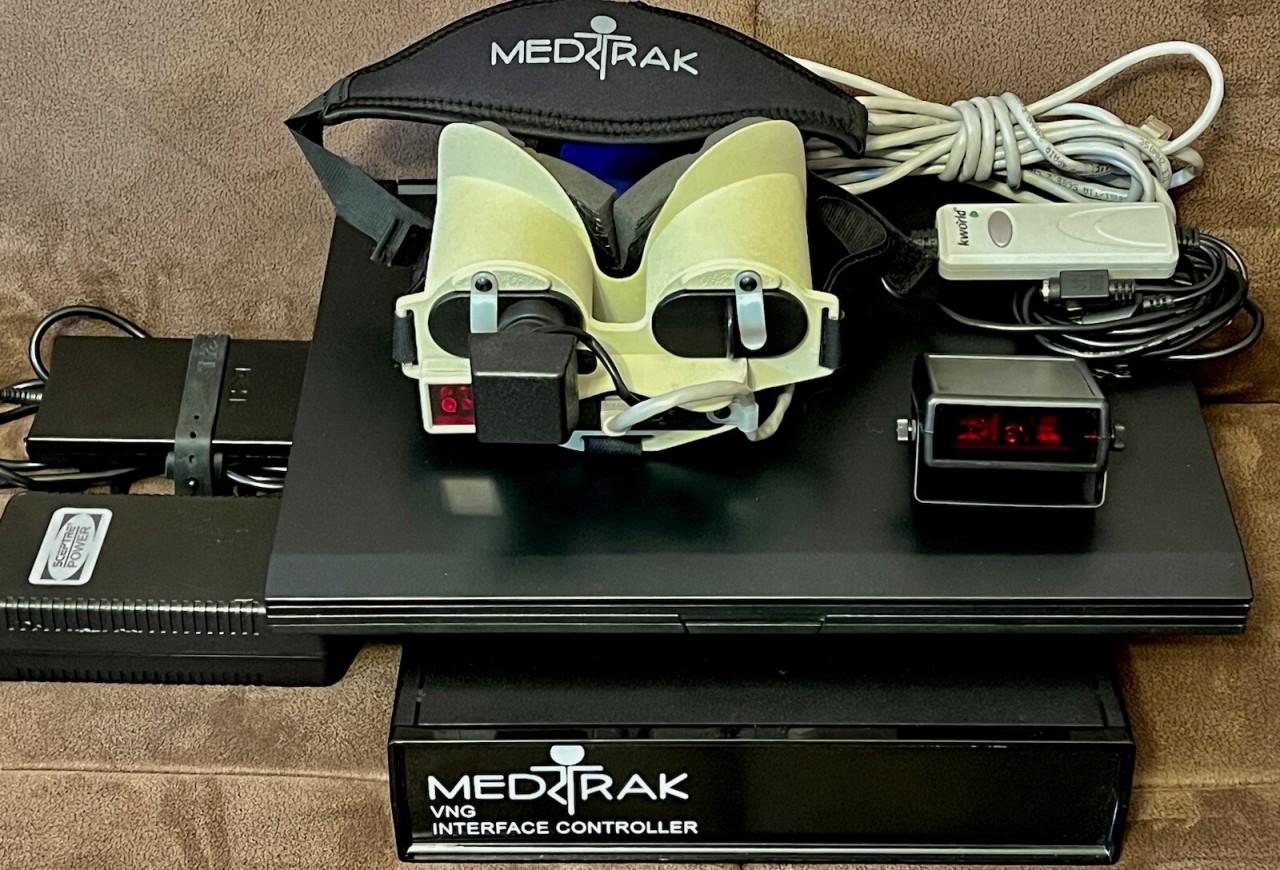
MEDTRAK IntelliNetX VNG VIDEONYSTAGMOGRAPHY COMPLETE DIAGNOSTIC SYSTEM


Product Description
INCLUDES:
- INTERFACE CONTROLLER (base)
- VNG GOGGLE w/ cable
- VORT AHR RECEIVER w/ cable
- SERIAL ADAPTOR CABLE
- VIDEO CAPTURE SOURCE
- DC POWER SUPPLY
- LAPTOP w/ MEDTRAK SOFTWARE 3.0
- TRAINING VIDEO
VNG Testing
For the VNG test, goggles are placed on the patient while an infrared camera connected to a computer measures nystagmus (eye movement) during different types of stimulation (visual, positional and caloric). A pattern of eye movement is recorded, producing data from which the practitioner is able to determine whether the pathology is of central or vestibular origin, whether it is ocular-motor, or whether the patient has benign paroxysmal positional vertigo (BPPV).
VNG analyzes the cause of a patients balance disorders by testing oculo-motor responses to visual, positional and caloric stimulus. The patients oculo-motor response is measured against objective criteria, and the practitioner receives an objectively measured assessment that differentiates between peripheral and central vestibular pathology. Results appear on the screen and a printout of normative data and the patients results are generated for the patients medical record.
WRITE A REVIEW